GS1 Sunrise 2027: The Transition to 2D Barcodes in Retail
Written by

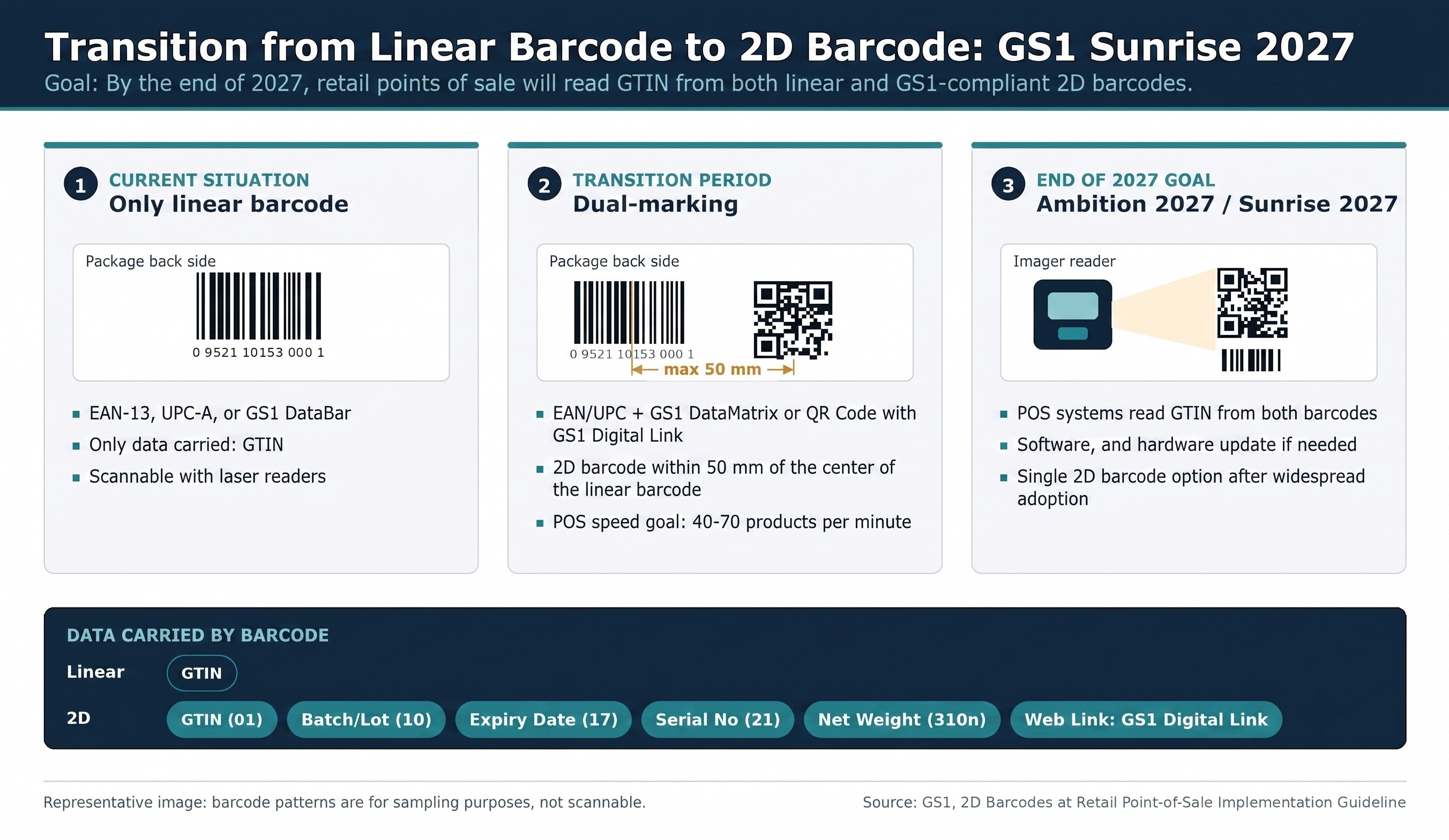
For more than fifty years, linear barcodes have automated product identification in the retail sector, but they have been limited to carrying only a single data element. GS1 Sunrise 2027 is a global industry initiative aimed at replacing this structure with two-dimensional (2D) barcodes capable of carrying significantly more information. According to the objective, also referred to as Ambition 2027, all retail point-of-sale systems are expected to be able to read and process GS1-compliant 2D barcodes alongside linear barcodes by the end of 2027.
Scope of the GS1 Sunrise 2027 Initiative
What Is GS1 Sunrise 2027?
GS1 Sunrise 2027 is not a deadline after which linear barcodes become invalid. Rather, it is a shared milestone established to ensure retail infrastructure is ready for 2D barcodes. The minimum objective is that a checkout scanner can capture the product identifier (GTIN) from both an EAN-13 barcode and a GS1-compliant 2D barcode and transmit it completely to the POS software. For example, even if a supermarket scanner can physically detect a QR code, the requirement is not fulfilled if it cannot interpret the embedded GS1 data.
The Data Limitations of Linear Barcodes
EAN-13 and UPC-A barcodes only carry the GTIN; they cannot include batch numbers, expiration dates, or serial numbers. GS1 DataBar Expanded partially addresses this limitation, but its capacity remains restricted and the symbol can become too large for smaller packages. For example, including weight, batch, and date information for fresh meat products in a single linear symbol may consume a substantial portion of the label area.
Accepted 2D Barcodes and Data Syntax
Only three options are accepted for point-of-sale use:
- GS1 DataMatrix — encoded using GS1 element string syntax
- QR Code — encoded using GS1 Digital Link URI syntax
- Data Matrix — encoded using GS1 Digital Link URI syntax
The element string structure represents data through GS1 Application Identifiers (AIs); batch number (10), expiration date (17), and serial number (21) are encoded using this format. Digital Link carries the same information in a web-address format, connecting the barcode to digital content. For example, a QR code printed on a canned food label may transmit the GTIN at checkout while also directing consumers to a web page dedicated to that specific batch.
Packaging and Production During the Transition Period
The Dual-Marking Period and Placement Rules
During the transition period, products will carry both a linear barcode and a 2D barcode, a practice known as dual-marking. According to GS1 guidance, this approach remains necessary until at least 90% of point-of-sale scanners can extract the GTIN from GS1-compliant 2D barcodes. Extensive testing has shown that, to maintain a checkout speed of approximately 40 to 70 products per minute, the 2D barcode should be positioned no more than 50 mm from the center of the linear barcode. For example, a QR code placed too far away may require the cashier to rotate the product twice.
Dynamic Data Printing and Print Quality
Because the GTIN is static, the linear barcode is typically pre-printed by the packaging supplier. A 2D barcode, however, may contain variable data that changes from batch to batch and therefore must often be printed in real time on the production line. This requires continuous inkjet (CIJ), thermal transfer, or laser printing systems to receive accurate information from manufacturing management systems.
Readability depends on contrast and module size. The X-dimension of 2D barcodes is approximately 1.5 times larger than that of an equivalent linear barcode, and colors such as red, orange, and yellow may create scanning risks due to the characteristics of red-light scanners. For example, a QR code containing a logo may fail at checkout if the logo consumes too much error-correction capacity. Therefore, verification should be repeated under production conditions according to ISO/IEC 15415.
Traceability, Compliance, and Preparation
Traceability and Targeted Recalls
The most significant operational advantage of a 2D barcode is the ability to identify products at the batch or serial level. When the GTIN, batch number, and expiration date can all be scanned, a recall can be limited to the affected batch instead of the entire product range. The same data can also prevent expired products from being sold at checkout. For example, a food manufacturer can determine from a serial number which production shift and which raw material batch were involved in manufacturing a product that became the subject of a complaint.
Regulatory Compliance and the Digital Product Passport
The transition to 2D barcodes aligns with evolving European Union regulations regarding product information. The Ecodesign for Sustainable Products Regulation entered into force on 18 July 2024 and places the Digital Product Passport at the center of the framework, while product-specific obligations are being defined gradually through secondary legislation. Since access to the passport is expected to be provided through a data carrier, the 2D barcode on the packaging becomes a compliance tool. In the pharmaceutical sector, for example, GS1 DataMatrix has been used for years as a serial-number carrier, demonstrating the practicality of the model.
Preparation Steps and Future Outlook
An effective transition begins with a product data inventory. Every product should be verified to have a valid GTIN, after which the data elements to be included in the barcode should be selected and tested within ERP and MES systems. In Türkiye, company prefixes and GTIN allocations are managed through GS1 Türkiye.
For example, a pilot project involving a limited number of product codes can identify print-quality issues at production speeds before they affect the entire portfolio. Once widespread adoption is achieved, the focus will shift from the barcode itself to the underlying data layer, including resolver services and visibility data.
Conclusion
GS1 Sunrise 2027 is not a cut-off date ending fifty years of linear barcode dominance. Instead, it is a shared goal designed to prepare retail infrastructure for data-rich barcodes. During the transition period, products will carry both barcode types, while compliance with placement and print-quality requirements will protect checkout efficiency. For manufacturers, the primary challenges lie not in packaging design but in GTIN accuracy, dynamic data printing, and reliable data processing.
For facilities that can reliably generate batch and serial numbers during production, transitioning to 2D barcodes is largely a matter of transferring existing data onto the packaging. For this reason, preparation should begin not with barcode selection, but with the point where production data is collected.
Frequently Asked Questions
Is GS1 Sunrise 2027 mandatory for manufacturers?
The initiative is defined as a voluntary transition for brand owners. Obligations arise primarily from point-of-sale readiness targets and product-specific regulations. In practice, the main driver of adoption will be retail chains requiring suppliers to provide products with 2D barcodes.
Will our existing EAN-13 barcodes become invalid in 2027?
No. Linear barcodes will continue to coexist with 2D barcodes for as long as necessary. During the transition period, products carrying a 2D barcode should also include a linear barcode. Once widespread adoption has been achieved, brand owners may choose to use only a 2D barcode on their packaging.
How should companies choose between GS1 DataMatrix and QR Code?
The choice depends on the use case. GS1 DataMatrix occupies less space and is widely accepted in healthcare products. QR Codes encoded using GS1 Digital Link syntax can be read by standard smartphone cameras and therefore provide advantages for products that require consumer interaction.
Meet Our End-to-End Traceability Solution
OnSuite Trace allows you to manage all your production processes from a single platform. We provide end-to-end digital traceability for your business with the motto "Continuous Control, Zero Defects".