RFID and Barcode Comparison: Choosing the Right Technology
Written by

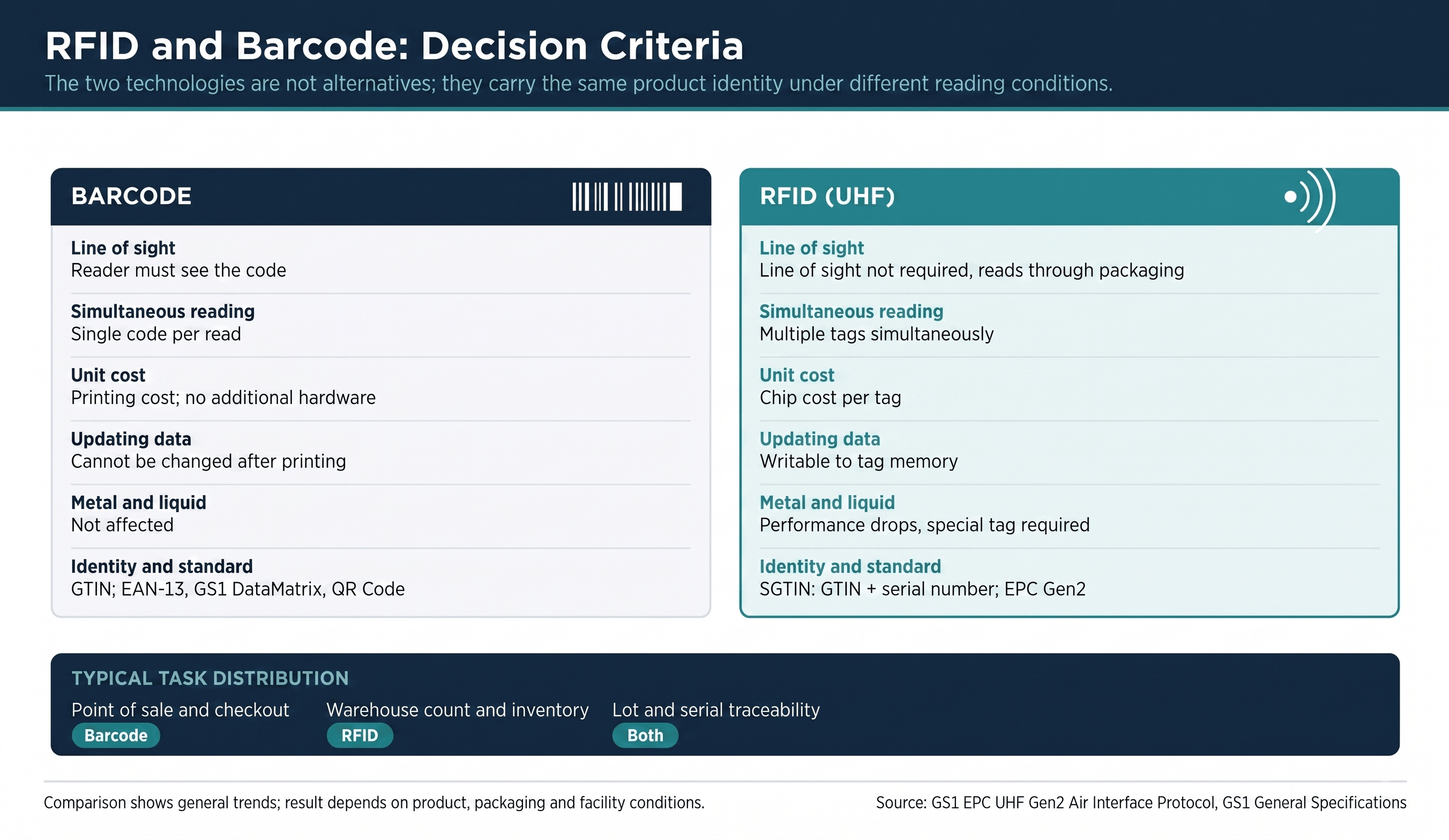
One of the most common questions asked when investing in traceability systems is whether product identification should be carried by a barcode or an RFID tag. The question is often framed as a comparison of superiority; however, these two technologies were developed to carry the same product identity under different reading conditions, and in most facilities they are used together rather than replacing one another.
The real question is not which technology is better, but which reading conditions require which identification carrier. As the importance of product traceability increases in modern manufacturing, choosing the right carrier directly drives return on investment. In this article, we compare RFID and barcode technologies in terms of line-of-sight requirements, reading capacity, cost structure, environmental conditions, and standards, then examine which technology is best suited for different traceability tasks.
RFID and Barcode Comparison: Technical Differences
Common Ground: The Product Identity Being Carried
Both technologies carry the same information: a unique identifier that distinguishes a product. In barcode systems, this identifier is encoded as a GTIN (Global Trade Item Number). In RFID systems, the identity is typically represented by a combination of the GTIN and a serial number, carrying the same meaning as the corresponding barcode data structure. Therefore, switching between the two technologies is not a transformation of data but simply another way of expressing the same identity in a different medium. For example, the barcode scanned at a checkout counter and the RFID tag attached to the same product both refer to the same product identifier.
Line of Sight and Reading Method
A barcode is an optical carrier, meaning the scanner must see the code in order to read it. RFID, on the other hand, uses radio frequency communication and does not require the tag to be visible. RFID tags can often be read through packaging, cartons, or containers. This difference becomes particularly noticeable in warehousing and packaging operations. For example, counting the products inside a sealed carton using barcodes would require opening the carton, whereas RFID enables all tagged items to be identified without opening it. However, because visibility is not required, it can be more difficult for operators to verify exactly which tag has been read.
Number of Units Read Simultaneously
A barcode scanner reads one code at a time, requiring an individual action for each product. RFID readers can rapidly interrogate multiple tags located within the reading zone. This significantly reduces inventory counting time but introduces a new challenge: unintended tag reads. For example, an RFID reader installed at a shipping gate may accidentally detect tags located on a pallet at a neighboring loading dock if the reading area is not properly controlled. As a result, the physical design and limitation of the reading zone often have a greater impact on RFID system performance than the reader itself.
Differences in Cost Structure
The cost of barcode identification is generally limited to printing. If the code is printed directly on packaging, no additional hardware needs to be attached to the product itself. RFID involves additional costs because every tagged item requires a chip and antenna. RFID deployments also require readers, antenna installations, integration work, and commissioning activities. For this reason, technology selection is often influenced by product value and operational benefits. In a high-volume, low-cost food product environment, RFID tag costs may not be justified, whereas in apparel retailing, inventory accuracy improvements often outweigh the additional expense.
Updating Data After Deployment
Once a barcode has been printed, its contents cannot be modified. If information changes, a new barcode must be generated and printed. RFID tags, however, can store data that may be written or updated during a process. This can be advantageous in applications where process status information must travel with the product itself. For example, information about the manufacturing operations completed on a reusable transport container can be written directly to the tag, allowing access even at stations that are temporarily disconnected from central systems. However, if a clear master source of truth is not defined, this flexibility can easily lead to data inconsistencies.
Impact of Metal, Liquids, and Operating Environment
Barcode performance is largely independent of the material beneath it, provided that the printed code remains visible and undamaged. RFID performance, however, can be negatively affected by nearby metal surfaces and liquids, often requiring specialized tag designs and carefully engineered antenna placement. Conversely, dirt, abrasion, and physical wear typically affect barcode readability more severely. For example, in an oily production environment, a barcode may become unreadable due to contamination, while a standard RFID tag attached to a metal component may also fail to achieve its expected reading distance unless specifically designed for that application.
Standards and Implementation
Standards: EPC Gen2 and GS1 Barcodes
Both technologies rely on open standards that ensure interoperability across systems and equipment manufacturers. For RFID, the EPC Gen2 air interface protocol defines communication between passive UHF tags and readers and is harmonized with ISO/IEC 18000-63. Barcode systems use established GS1 barcode systems used in traceability such as EAN-13, GS1 DataMatrix, and QR Codes, all of which can represent the same underlying product identity. As a result, standards-compliant tags and codes can typically be read by equipment from different vendors without requiring extensive customization.
Which Technology Is Suitable for Which Task?
Point-of-sale and checkout operations remain the natural domain of barcodes. According to the GS1 2D retail transition guidelines, retail is shifting towards 2D codes with the GS1 Sunrise 2027 transition, while RFID adoption accelerates in inventory management, particularly in apparel retail where counting speed provides measurable gains. Warehouse counting, stock verification, and loss-prevention applications are areas where RFID clearly excels. Traceability at the batch or serial number level can be achieved using either technology. In many cases, the same product may carry both identification methods, with barcodes being used at checkout and RFID being used in warehouse operations, while both reference a single product identity.
Combined Use and System Architecture
In practice, a common approach is to use both carriers on the same product. For example, a retail hang tag may contain a printed barcode as well as an embedded RFID chip. The critical requirement is not the choice of carrier itself, but ensuring that both reading channels point to the same product identity and feed data into a common event management structure. Otherwise, separate inventories may gradually diverge from one another. For example, if RFID events update the warehouse system while barcode scans update the production system independently, determining the correct inventory position can become a source of operational conflict.
Conclusion
The comparison between RFID and barcode technology is not a competition in which one technology eliminates the need for the other. Barcodes continue to serve as the primary product identification carrier due to their extremely low unit cost and widespread use at points of sale. RFID delivers significant advantages in inventory accuracy and bulk-reading capabilities because it does not require line-of-sight access and can identify many items in a short period of time. Cost structure, environmental conditions, and the need to update information after deployment are the three primary factors influencing technology selection.
Therefore, the right question is not which technology is better, but which technology best fits the reading conditions of a specific traceability task. When both technologies share the same product identity and all event records are consolidated within a common system architecture, the decision becomes less about technological trade-offs and more about designing the most effective operational process.
Frequently Asked Questions
Will RFID Replace Barcodes?
This is unlikely in the foreseeable future. Barcodes continue to offer substantial cost advantages, particularly at points of sale and for low-cost products. RFID adoption is growing in applications where inventory accuracy and rapid counting are essential, and both technologies are expected to coexist in most facilities.
Can a Product Use Both RFID and a Barcode?
Yes. This is a common and widely accepted practice. Retail hang tags are a typical example. The key requirement is that both carriers represent the same product identity and that all read events are collected within a single system. Otherwise, conflicting inventory records may emerge.
When Does RFID Fail to Deliver Expected Results?
RFID performance can decline near metal surfaces and liquids, making specialized tags and antenna configurations necessary. Additionally, installations that do not properly control the reading zone may capture unintended tags, leading to inaccurate inventory or shipment records.
Siskon Traceability Solutions
With Siskon Traceability Solutions, you can manage all your production processes from a single platform.
Siskon Traceability Solutions enables real-time monitoring, historical reporting, and analytical evaluation of manufacturing operations by collecting production-related data such as test results, measurements, materials used, target and actual process parameters, visual inspection records, repair information, and data gathered from sample measurement stations. The platform supports operational processes including material flow, work order management, tool management, and energy consumption tracking. It also helps capture and digitize critical production information that may exist outside automated workflows.
Through horizontal and vertical integrations, the system provides complete digital visibility across the factory and enterprise, enabling organizations to monitor, control, and optimize their manufacturing operations from end to end.
With the motto “Continuous Control, Zero Defects”, achieve end-to-end digital traceability throughout your entire organization.
Meet Our End-to-End Traceability Solution
OnSuite Trace allows you to manage all your production processes from a single platform. We provide end-to-end digital traceability for your business with the motto "Continuous Control, Zero Defects".